

Building Real-Time Email Alerts for a SOC System (Elastic Stack + Node.js)
April 12, 2026 | by ziaeework

Introduction
In a modern Security Operations Center (SOC), detecting threats is not enough — timely notification is critical. While dashboards provide visibility, real-time alerting ensures immediate response to security incidents.
In this phase of my project, I implemented multi-channel alerting (Telegram + Email) along with an anti-spam mechanism, transforming the system into a more realistic SOC solution.
Why Multi-Channel Alerting?
Relying on a single alerting channel is risky. By combining Telegram and Email, we gain:
- Instant notifications (Telegram)
- Reliable communication (Email)
- Redundancy in alert delivery
Detection Logic
The system monitors Windows Security logs:
- Event ID 4625 → Failed login attempt
- Aggregation by username
- Threshold-based detection
Rule:
If failed login attempts ≥ 5 → Trigger alert
Backend API
GET /api/detect/bruteforce
This endpoint:
- Queries ElasticSearch
- Aggregates failed login attempts
- Applies detection rules
- Sends alerts
Alerting Implementation
🔸 Telegram
await axios.post(`https://api.telegram.org/bot<TOKEN>/sendMessage`, {
  chat_id: "<CHAT_ID>",
  text: message
});
await transporter.sendMail({
  from: 'your_email@gmail.com',
  to: 'receiver@gmail.com',
  subject: '🚨 SOC Alert - Brute Force Detected',
  text: message
});
Multi-Channel Trigger
await sendTelegramAlert(msg);
await sendEmailAlert(msg);
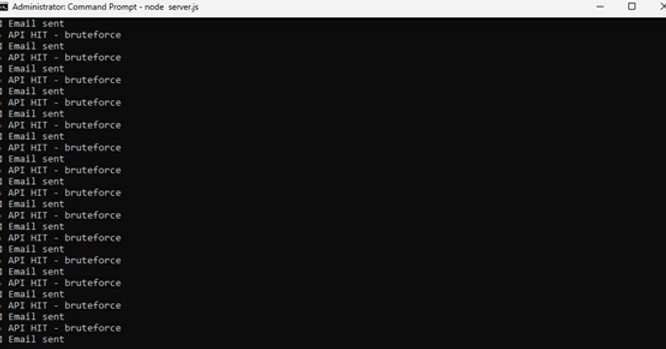
Preventing Alert Spam (Cooldown Mechanism)
One major challenge in real-world SOC systems is alert flooding. Without control, the system may send hundreds of alerts for the same attack.
To solve this, I implemented a cooldown mechanism.
Concept
- Store the last alert time per user
- Only send a new alert if enough time has passed
Implementation
const alertCache = {};
const COOLDOWN = 60 * 1000; // 1 minute

for (let user of buckets) {

  const now = Date.now();
  const lastTime = alertCache[user.key] || 0;

  if (user.doc_count >= 5 && (now - lastTime > COOLDOWN)) {

    const msg = "🚨 Brute Force Detected!\nUser: "
      + user.key + "\nAttempts: " + user.doc_count;

    await sendTelegramAlert(msg);
    await sendEmailAlert(msg);

    alertCache[user.key] = now;
  }
}
Result
- ❌ No more alert spam
- ✅ Controlled notifications
- ✅ More realistic SOC behavior
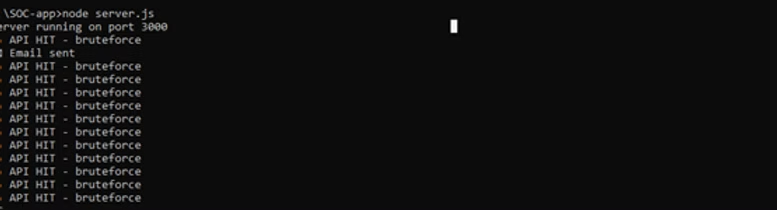
Testing
After generating multiple failed login attempts:
- Alerts were triggered once
- No repeated spam within the cooldown period
Challenges & Lessons Learned
- ❗ Avoiding duplicate alerts
- ❗ Managing async alert flows
- ❗ Debugging Telegram & SMTP errors
- ❗ Designing realistic detection logic
Outcome
The system now includes:
- Real-time brute-force detection
- Telegram alerting
- Email alerting
- Anti-spam cooldown logic
Conclusion
By adding a cooldown mechanism, the alerting system becomes significantly more practical and production-ready. This ensures that security teams receive meaningful alerts without being overwhelmed.
🚨 From detection to intelligent alerting — building real-world SOC systems step by step.
RELATED POSTS
View all


Securing Data Science Systems: Why Small Changes Can Have Big Consequences
May 3, 2026 | by ziaeework
Quantum cybersecurity and Artificial Intelligence (AI)
April 10, 2025 | by ziaeework