

What Exactly Is a Qubit, and What Is It Made Of?
July 20, 2026 | by ziaeework

➡️What Exactly Is a Qubit, and What Is It Made Of?
Classical bits can hold only one of two definite values:
0 or 1
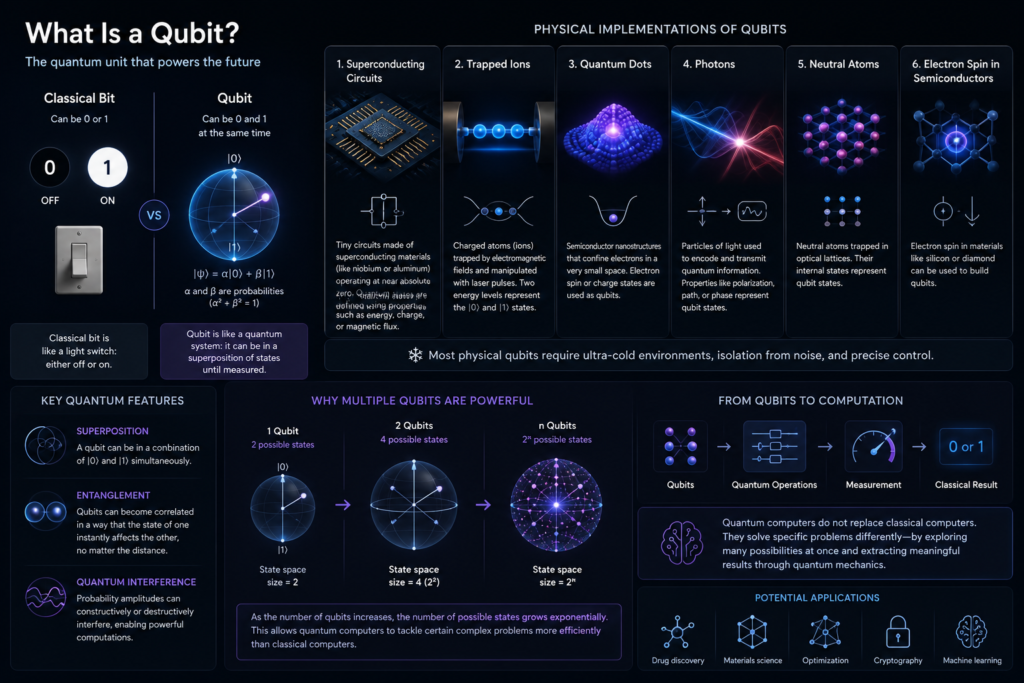
A classical bit can be compared to a light switch that, at any given moment, is either off or on.
A qubit, however the fundamental unit of information in quantum computing behaves very differently.
➡️ What Is a Qubit Made Of?
A qubit is a physical quantum system with two basis states used to represent information. These two states are typically labeled as zero and one.
Unlike a classical bit, however, the state of a qubit can be a quantum combination of these two basis states.
Qubits can be physically implemented using several different technologies and quantum systems.
➡️1. Superconducting Circuits
One of the most widely used approaches to building qubits involves extremely small superconducting circuits.
These circuits are typically made from materials such as aluminum or niobium and operate at extremely low temperatures, close to absolute zero.
The quantum properties of the circuit are used to define the two basis states of the qubit.
Depending on the design, these states may be associated with differences in energy, electrical charge, or magnetic flux.
In some architectures, such as flux-based qubits, quantum superposition can involve states associated with different directions of current flow within the circuit.
Several companies and research institutions use superconducting quantum technologies, although their specific qubit designs and architectures are not necessarily the same.
➡️ 2. Trapped Ions
This approach uses electrically charged atoms, known as ions.
The ions are trapped using electromagnetic fields in a highly controlled environment, while laser pulses are used to manipulate and measure their quantum states.
Two selected energy levels of an ion can serve as the zero and one basis states of a qubit.
➡️ 3. Quantum Dots
Quantum dots are extremely small semiconductor structures that can confine electrons within a very small region.
Properties such as electron spin can then be used to store and process quantum information.
➡️ 4. Photons
Photons the particles of light can also be used to encode and transmit quantum information.
In photonic quantum systems, properties such as polarization, optical path, or other degrees of freedom can be used to represent qubit states.
➡️ 5. Neutral Atoms and Electron Spins
Other quantum computing architectures use neutral atoms or the spin of electrons in materials such as silicon or diamond to create qubits.
Each of these technologies has its own advantages and limitations in terms of stability, control, error rates, and scalability to larger numbers of qubits.
➡️What Is the Main Difference Between a Bit and a Qubit?
A classical bit has one definite value at any given moment:
➡️0 or 1
A qubit, before measurement, can exist in a state known as quantum superposition.
This means that the state of the qubit can be a combination of the zero and one basis states.
When the qubit is measured, the result is either zero or one, with probabilities determined by its quantum state.
Importantly, the potential power of quantum computing does not come from the superposition of a single qubit alone.
The capabilities of quantum computing arise from the combination of several fundamental quantum phenomena, including superposition, entanglement, and quantum interference.
These properties allow quantum algorithms to represent highly complex state spaces and, for certain specific problems, process information in ways fundamentally different from classical computing.
Therefore, it is not entirely accurate to say that one qubit is simply more powerful than one classical bit.
The potential computational advantage emerges when multiple qubits interact in a controlled quantum system and when an appropriate quantum algorithm exists for the problem being addressed.
➡️ In Simple Terms
A classical bit can be compared to a light switch that is either off or on.
A qubit is better understood as a quantum system that, before measurement, can exist in a combination of two basis states.
When many qubits interact through superposition, entanglement, and quantum interference, the state space of the system grows extremely rapidly.
And it is precisely this characteristic that makes quantum computing an important field for investigating certain complex problems and potentially navigating extremely large spaces of possibilities.
RELATED POSTS
View all


Super singular Isogeny-Based Cryptography for Applications
March 7, 2025 | by ziaeework
Securing Data Science Systems: Why Small Changes Can Have Big Consequences
May 3, 2026 | by ziaeework