
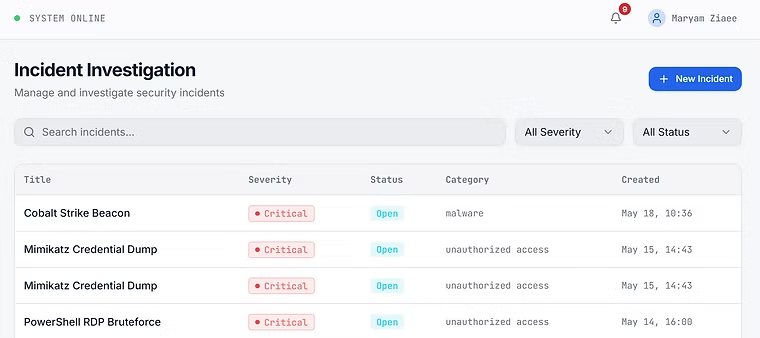
Over the last phase of development, I transformed the SECOPS Platform from a basic incident dashboard into an AI-enhanced security investigation pipeline capable of ingesting, enriching, correlating, and investigating security incidents automatically.
The platform architecture now includes:
Elasticsearch
↓
FastAPI Backend
↓
Incident Normalization
↓
MITRE ATT&CK Mapping
↓
Risk Scoring Engine
↓
Incident Correlation
↓
Context Collection
↓
AI Triage Engine
↓
Autonomous Investigation
↓
Timeline Reconstruction
↓
Threat Intelligence Enrichment
↓
Live SOC Dashboard
Key Features Implemented
Real-Time Incident Ingestion
Created authenticated FastAPI ingestion endpoints capable of receiving security incidents from Elastic detections and external systems.
Example ingestion test:
curl -X POST http://localhost:…./incident \
-H “Authorization: Bearer token \
-H “Content-Type: application/json” \
-d ‘{
“title”:”SSH Bruteforce”,
“severity”:”high”,
“category”:”unauthorized_access”,
“ip”:”192.168…”
}’
MITRE ATT&CK Mapping
The backend now automatically maps incidents to MITRE ATT&CK tactics and techniques.
Examples:
- T1110 → Brute Force
- Credential Access
- Remote Access Abuse
- PowerShell-related activity
AI Triage Engine
Implemented an AI triage layer capable of generating:
- incident summaries
- severity reasoning
- investigation recommendations
- attack explanations
Example output:
“This incident appears to involve PowerShell RDP Bruteforce activity…”
Timeline Reconstruction
Built timeline generation logic to reconstruct attack progression:
- initial detection
- suspicious activity
- escalation events
- AI triage execution
- investigation execution
Threat Intelligence Enrichment
Added IOC enrichment and attacker context generation:
- malicious IP reputation
- suspicious activity patterns
- known attack behavior
- Recommended response actions
Real Engineering Challenges Solved
This phase involved solving multiple real-world backend engineering and infrastructure problems:
- FastAPI routing failures
- Uvicorn process conflicts
- PM2 reload issues
- Elasticsearch version mismatches
- API synchronization inconsistencies
- frontend/backend state conflicts
- ingestion debugging
- live dashboard synchronization
- route registration issues
- Python virtual environment recovery
Core Technologies
- Python
- FastAPI
- Elasticsearch
- Uvicorn
- PM2
- Nginx
- JavaScript frontend
- MITRE ATT&CK
- AI-assisted investigation workflows


RELATED POSTS
View all