
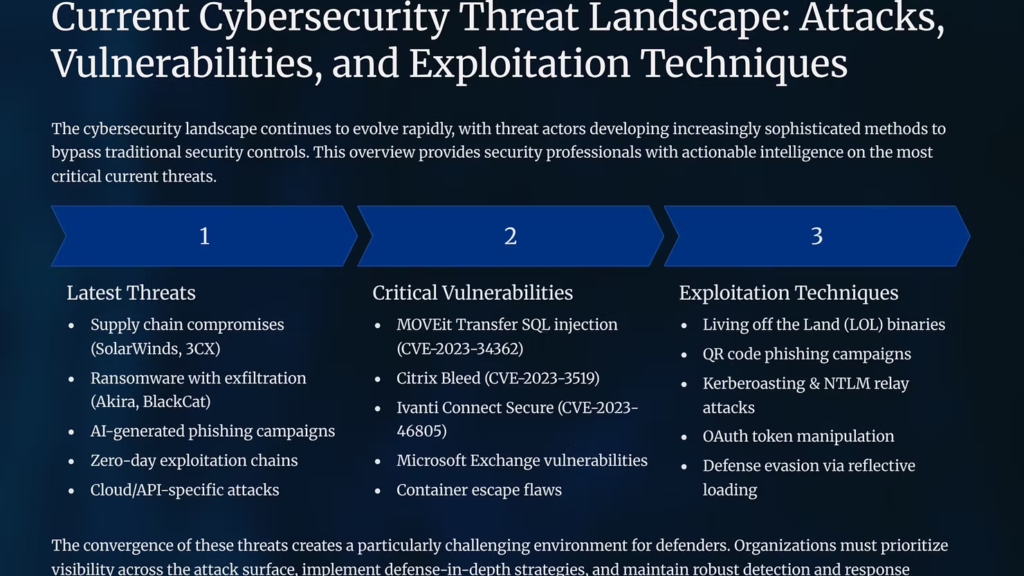
1. Supply Chain Attacks
— Compromising third-party software or services to infiltrate target organizations (e.g., SolarWinds, MOVEit Transfer breaches).
— Dependency confusion and malicious package injection in open-source ecosystems (NPM, PyPI).
2. Ransomware Evolution.
— Double and triple extortion: Not just encrypting data, but also stealing and threatening to leak sensitive information, or attacking customers/partners.
— Ransomware-as-a-Service (RaaS) platforms are lowering the barrier for attackers.
3. AI-Powered Phishing & Social Engineering
— Deepfake audio/video used for impersonation.
— AI-generated spear-phishing emails that evade traditional filters.
4. Zero-Day Exploits
— Attackers rapidly exploit new vulnerabilities before patches are available (e.g., Microsoft Exchange ‘ProxyNotShell’, MOVEit SQLi, Citrix Bleed).
5. Cloud-Specific Attacks
— Exploiting misconfigured storage buckets, IAM roles, serverless functions (Lambda, Azure Functions).
— Abuse of cloud metadata services (e.g., SSRF to retrieve AWS credentials).
— Attacks on multi-cloud environments and supply chain integrations.
6. API Attacks
— Business logic abuse, mass assignment, Broken Object Level Authorization (BOLA), and insufficient rate limiting.
— Automated tools targeting exposed APIs.
7. Credential Stuffing & MFA Bypass
— Exploiting reused credentials from data breaches.
— New techniques to bypass multifactor authentication (MFA fatigue, push bombing, SIM swapping).
8. IoT and OT (Operational Technology) Attacks
— Targeting connected devices, industrial control systems, and critical infrastructure.
— Exploiting weak authentication and outdated firmware.
Latest Vulnerabilities
1. MOVEit Transfer SQL Injection (CVE-2023-34362)**
— Widespread data breaches via SQLi in file transfer software.
2. Citrix Bleed (CVE-2023-4966)
— Sensitive data leakage from Citrix NetScaler appliances.
3. Ivanti Zero-Days (CVE-2023-35078, CVE-2023-35081, etc.)
— Remote code execution and authentication bypass in VPN appliances.
4. Microsoft Exchange/Outlook Zero-Days.
— ProxyNotShell, Follina, and other critical RCE and privilege escalation vulnerabilities.
5. Web Application Vulnerabilities
— Persistent Cross-Site Scripting (XSS) in popular platforms.
— Remote code execution in plugins and CMSs (WordPress, Drupal).
6. Container Escape Vulnerabilities
— Privilege escalation from containers to host (e.g., runc, containerd flaws).
7. Vulnerabilities in widely used libraries
— Deserialization flaws, log injection (e.g., Log4Shell aftermath), and outdated dependencies.
Latest Exploitation Techniques
1. Living off the Land (LotL)
— Using built-in tools (PowerShell, Windows Management Instrumentation) to avoid detection.
2. **Initial Access via Phishing, QR Codes, and Malicious Links
— QR code phishing (Quishing) targeting mobile users.
3. Active Directory & Kerberos Attacks
— Kerberoasting, Pass-the-Ticket, Silver Ticket attacks, ADCS (Active Directory Certificate Services) abuse.
4. Abusing Cloud Authentication Flows
— Exploiting OAuth misconfigurations, token theft, and misused SSO integrations.
5. Exploitation of API Vulnerabilities
— Automated tools for BOLA, mass assignment, and privilege escalation.
6. Bypassing Modern Defences
— Evasion of EDR/XDR using fileless malware, memory injection, and LOLBins.
7. Supply Chain Poisoning
— Typosquatting, dependency confusion, and malicious code in open-source packages.
Staying Updated
— Monitor resources like [CVE Details](https://www.cvedetails.com), [MITRE ATT&CK](https://attack.mitre.org/), [CISA Alerts](https://www.cisa.gov/news
RELATED POSTS
View all