Modern Adversarial Attacks in Deep Learning: Methods, Trends, and Challenges
May 4, 2026 | by ziaeework

Introduction
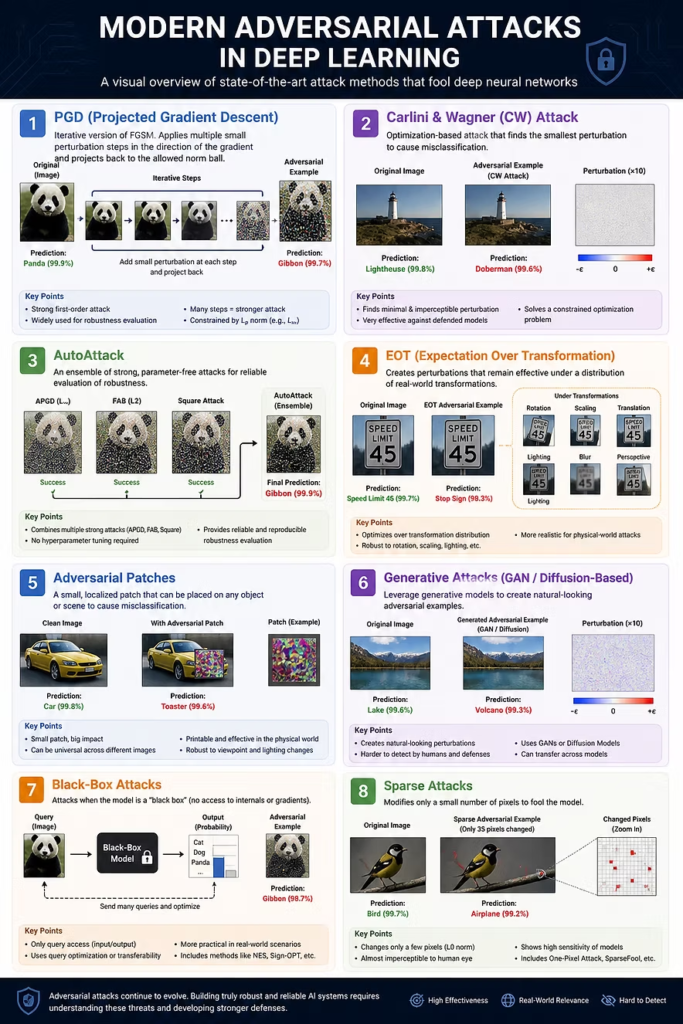
Adversarial examples are carefully perturbed inputs designed to mislead machine learning models while remaining nearly indistinguishable to humans. Over the past decade, research in adversarial machine learning has evolved from simple gradient-based perturbations to sophisticated, real-world attack strategies that challenge even state-of-the-art models.
This article provides a scientific overview of modern adversarial attack methods, their underlying principles, and current trends.
1. Projected Gradient Descent (PGD)
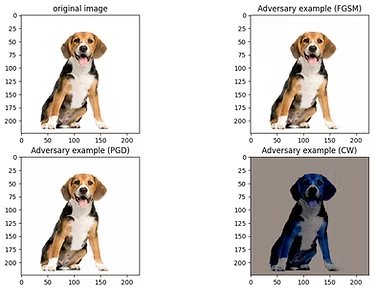
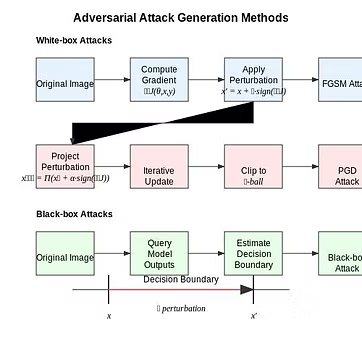
Projected Gradient Descent (PGD) is an iterative extension of the Fast Gradient Sign Method (FGSM). Instead of applying a single-step perturbation, PGD performs multiple small updates:
- At each step, the input is perturbed in the direction of the gradient that maximizes the model’s loss.
- The perturbation is projected back into a constrained norm ball (e.g., (L_\infty)) to ensure imperceptibility.
Key properties:
- Strong first-order adversary
- Widely used in adversarial training
- Considered a baseline for robustness evaluation
2. Carlini & Wagner (CW) Attack
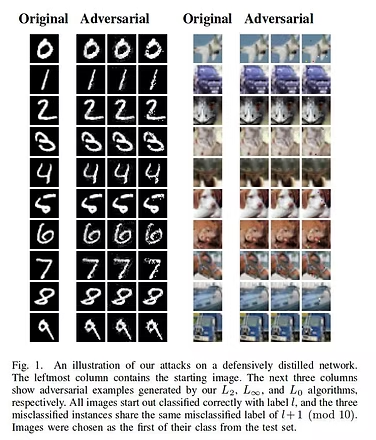
The Carlini & Wagner attack is a powerful optimization-based method designed to find minimal perturbations that cause misclassification.
Characteristics:
- Formulated as a constrained optimization problem
- Produces highly imperceptible perturbations
- Effective against defensively trained models
CW attacks often outperform simpler gradient-based methods in terms of stealth and success rate.
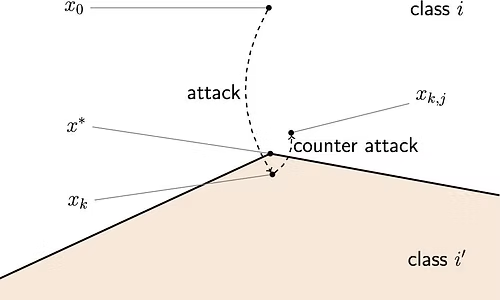
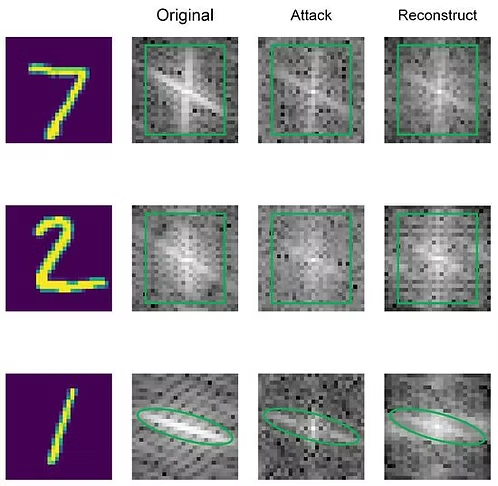
These images typically illustrate the key idea behind the Carlini & Wagner (CW) Attack:
- The original image appears almost unchanged to the human eye
- A very small, nearly imperceptible perturbation is added
- Despite this minimal change, the model’s prediction is completely altered
For a website or scientific presentation, this type of visualization effectively conveys the concept of “minimal perturbation, maximum impact.”
3. AutoAttack
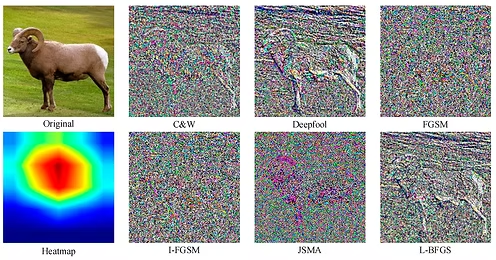
AutoAttack is a standardized ensemble of parameter-free attacks used for robust evaluation.
Components typically include:
- APGD (Auto-PGD, untargeted and targeted)
- FAB (Fast Adaptive Boundary attack)
- Square Attack (black-box)
Advantages:
- No need for manual hyperparameter tuning
- Provides reliable and reproducible robustness benchmarks
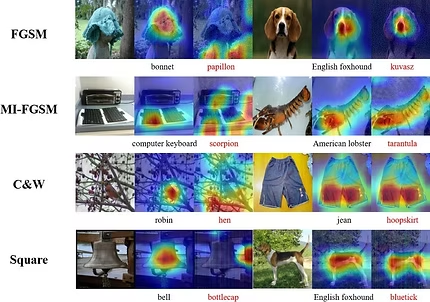
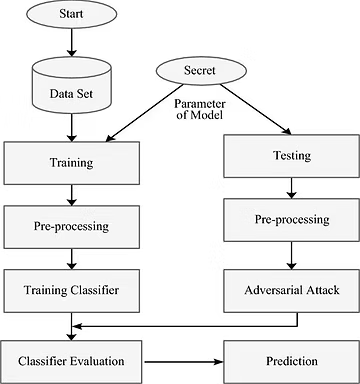
These visuals typically illustrate how AutoAttack works as an ensemble of attacks:
- Multiple attack methods (e.g., APGD, FAB, Square Attack) are applied
- Each method tries to fool the model in a different way
- The strongest successful perturbation is selected
This makes AutoAttack a reliable benchmark for evaluating model robustness.
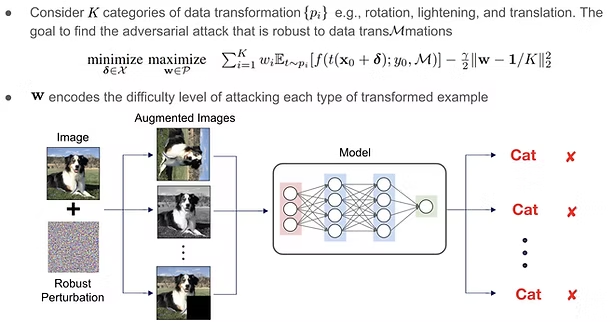
4. Expectation Over Transformation (EOT)
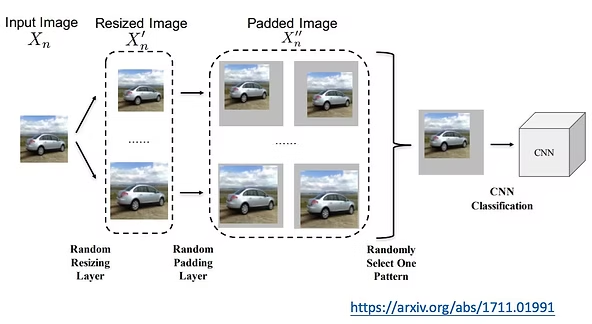
Expectation Over Transformation (EOT) extends adversarial attacks to real-world settings by optimizing perturbations over a distribution of transformations.
These transformations may include:
- Rotation
- Scaling
- Translation
- Lighting variations
Impact:
- Enables physically robust adversarial examples
- Critical for attacks in real-world environments (e.g., autonomous driving)
5. Adversarial Patches
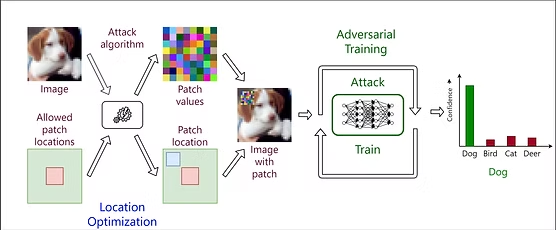
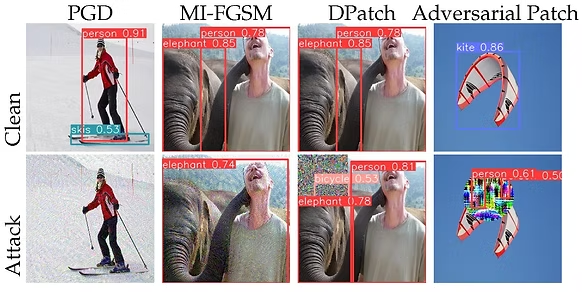
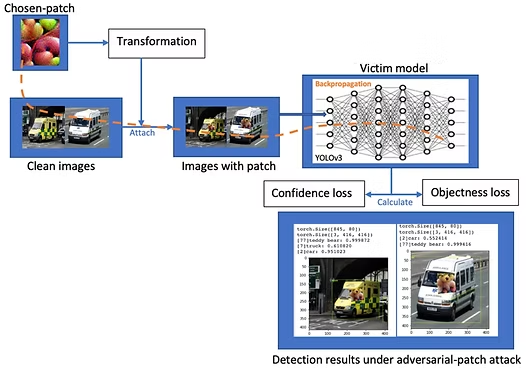
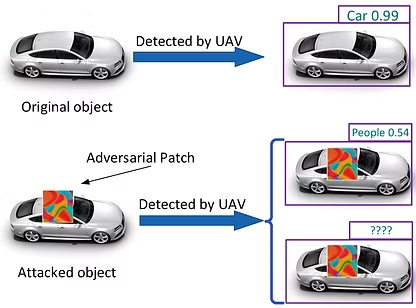
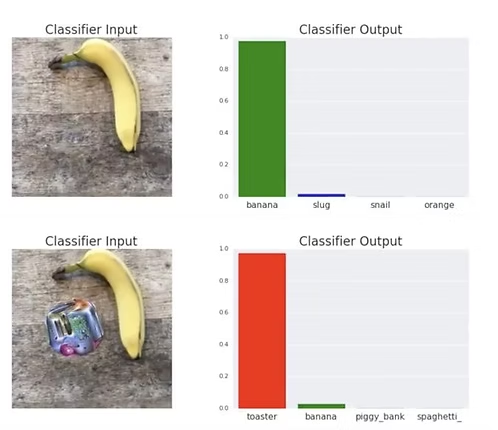
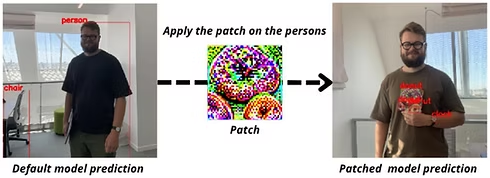
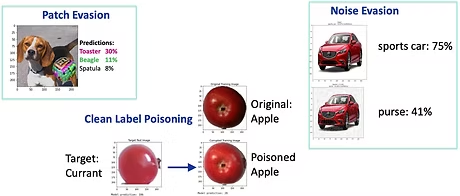
Adversarial patches are localized perturbations that can be applied to any scene and still cause misclassification.
Features:
- Spatially constrained (small region)
- Universal across different inputs
- Robust to transformations
They are particularly relevant in physical attacks, such as stickers placed on objects.
These examples illustrate how adversarial patches work:
- A small, localized pattern is added to the scene
- The rest of the image remains unchanged
- The model’s prediction is completely altered
This makes patches especially powerful in real-world scenarios, since they can be printed and physically placed on objects while still fooling AI systems.
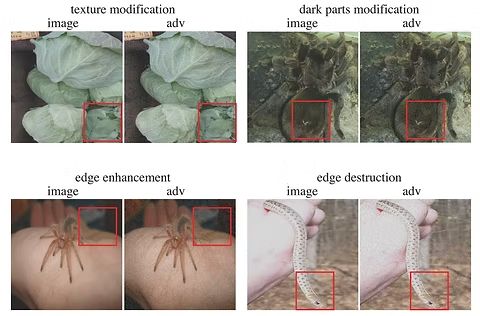
6. Generative Attacks (GAN and Diffusion-Based)
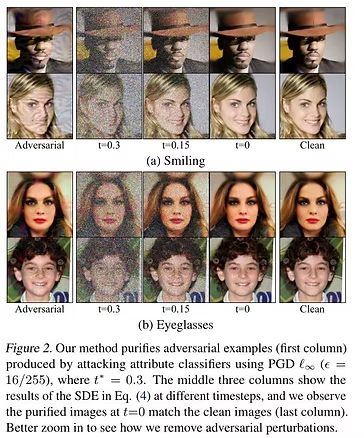
Recent advances leverage generative models to produce adversarial examples that appear natural rather than noisy.
Approaches include:
- GAN-based perturbation generation
- Diffusion model-based adversarial synthesis
Benefits:
- High perceptual realism
- Increased difficulty for human detection
- Potential to bypass traditional defenses
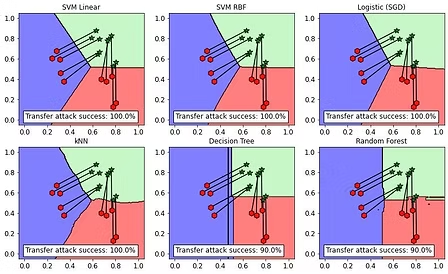
7. Black-Box Attacks
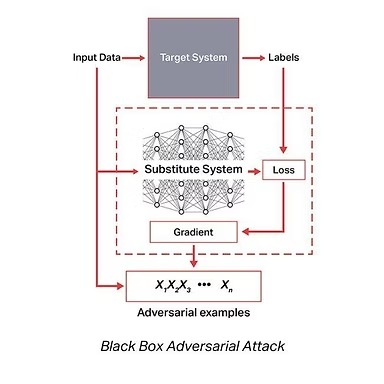
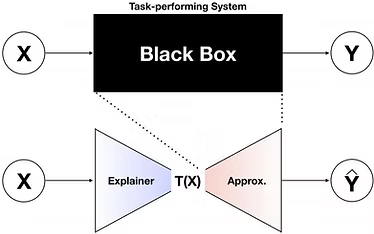
Black-box attacks assume no access to model gradients or internal parameters.
Techniques:
- Query-based optimization
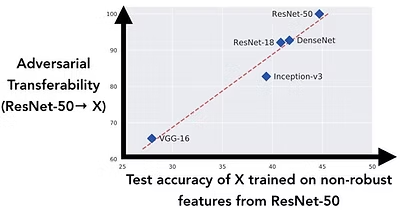
- Transferability from surrogate models
Importance:
- More realistic in deployed systems
- Demonstrates vulnerabilities even without internal access
These visuals typically show the core idea behind black-box attacks:
- The attacker has no access to model internals (no gradients, no architecture)
- Only input → output queries are available
- Attacks are generated via:
- Query-based optimization, or
- Transferability from a surrogate model
This makes black-box attacks especially relevant in real-world deployed systems, where internal model details are not exposed.
8. Sparse Attacks
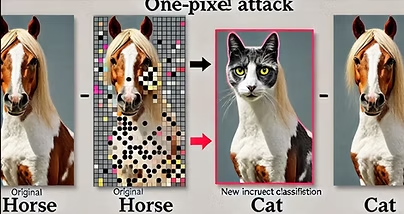
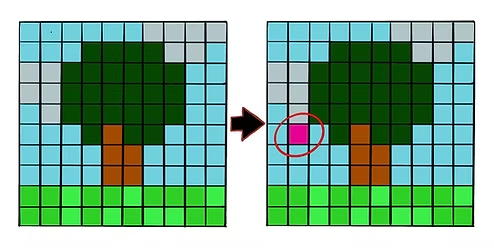
Sparse attacks aim to modify only a small subset of input features (e.g., a few pixels).
Characteristics:
- Minimal perturbation footprint
- High interpretability
- Demonstrates the sensitivity of models to small localized changes
These images demonstrate how sparse attacks operate:
- Only a very small number of pixels are modified
- The changes are often barely noticeable to humans
- Despite minimal alteration, the model’s prediction can change drastically
This highlights how sensitive deep learning models can be to even extremely localized perturbations.
Trends in Modern Adversarial Research
Recent developments show a clear shift:
- From single-step perturbations → to iterative and optimization-based attacks
- From digital-only attacks → to physically realizable attacks
- From visible noise → to natural-looking perturbations
- From single-input attacks → to universal and transferable attacks
Conclusion
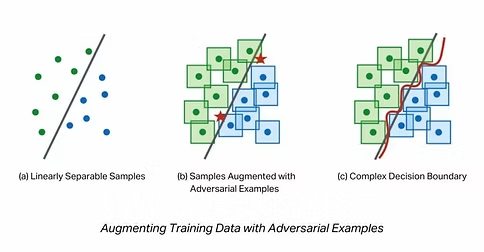
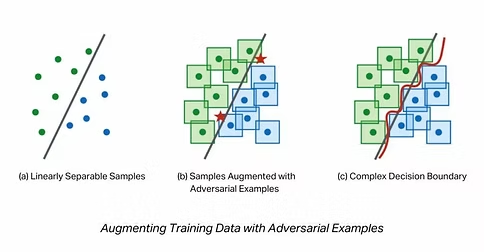
Despite significant progress in adversarial robustness (e.g., adversarial training, data augmentation, and architecture improvements), modern attack methods continue to expose fundamental vulnerabilities in deep learning systems.
Understanding these attacks is essential not only for improving model robustness but also for ensuring the safe deployment of AI systems in real-world applications.
Keywords
Adversarial Examples, Robustness, Deep Learning Security, PGD, CW Attack, AutoAttack, EOT, Adversarial Patch, Black-Box Attacks, Generative Models
Modern Adversarial Attacks in Deep Learning: A Visual Guide to Methods, Mechanisms, and Robustness
RELATED POSTS
View all